On the Hunt: Unsealing the Lynyrd Skynyrd Consent Order
Some big news in Skynyrd Nation. On Wednesday, March 4, I filed a motion asking a federal judge in Manhattan to unseal the Consent Order that has governed the activities of Lynyrd Skynyrd since 1988.
Few people know the Order exists and even fewer know what the document stipulates. I don’t believe the New York Times ever wrote about it, even though the deal went down four miles from its newsroom. I first read of its existence in the April 1999 of Spin magazine, which ran a long article about the band’s history of mayhem. The article mentioned the so-called “Rule of Three,” by which the band’s personnel must include co-founder Gary Rossington – plus at least two other members from the pre-crash lineup.
I wrote a lot about the Order when I was a reporter at Reuters, especially as band members started dying off and the Rule of Three was clearly ignored. But I never saw the actual document — because it is sealed — and assumed it was a single piece of paper laying out the personnel restriction.
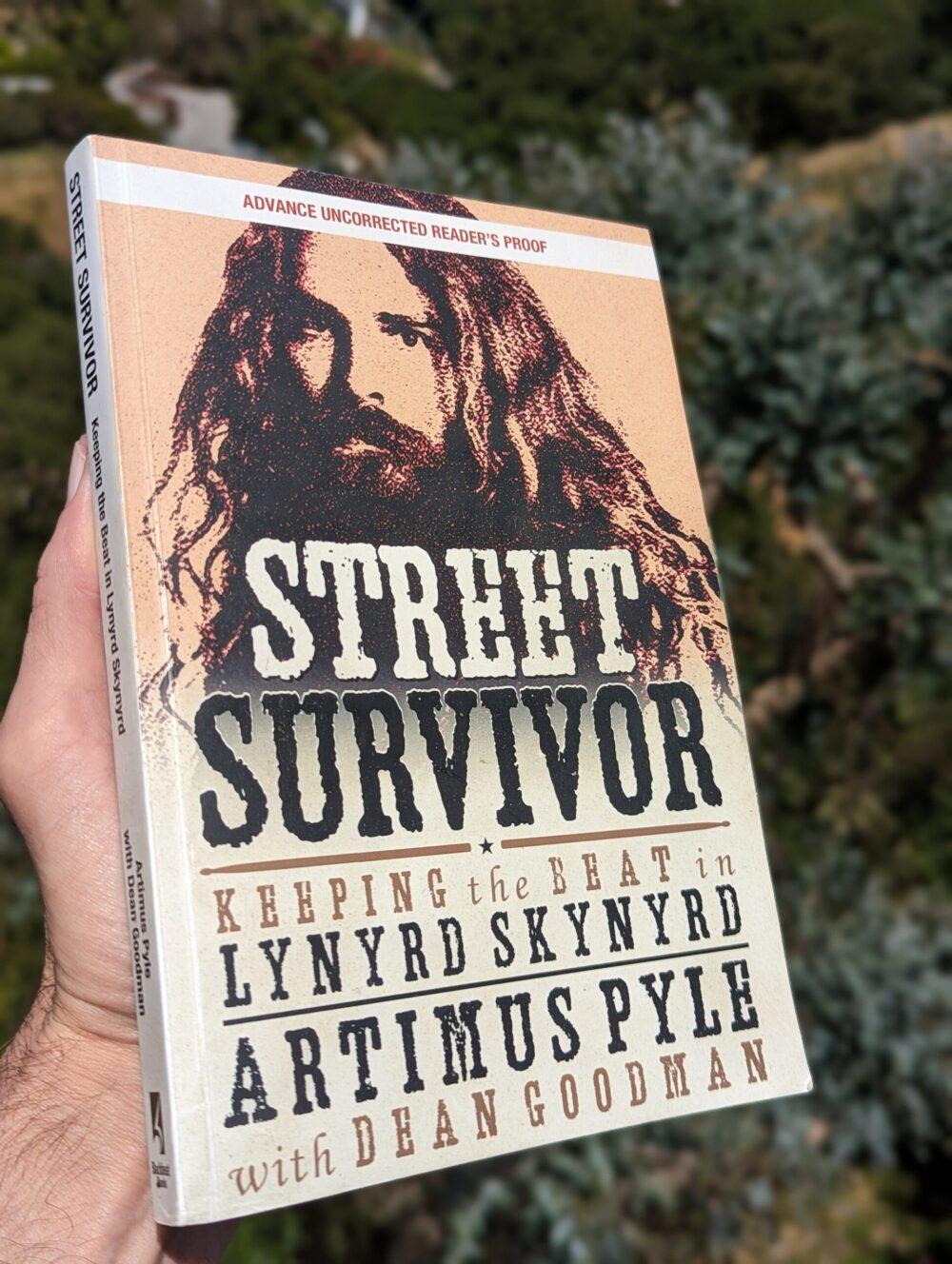
So I was quite surprised to come across it while working with Artimus Pyle on his memoir a decade ago. (See the history on the memoir here.) The Order runs about 30 pages plus appendices and covers a lot of ground — none of which I can really go into, although some of it, such as the Rule of Three, has been quoted in previous litigation:
For purposes of live musical performances, either both [Gary] Rossington and [Allen] Collins must appear on stage together as active players for substantially the entire duration of the live performance, or Rossington or Collins must appear along with two of the following four musicians: [Artimus] Pyle, Leon Wilkeson, Billy Powell, or Ed King. (Ronnie Van Zant, Inc. v. Artimus Pyle, 17 Civ. 3360 (S.D.N.Y.))
In case you’ve lost count, the only person in the above paragraph still alive is Artimus Pyle.
What is a Consent Order?
Also known as a consent decree, it’s a court document that binds the parties in an agreement that is approved and overseen by a judge. It’s often used in civil rights cases, e.g., a decree that controls a police force. The only other decrees I could find in the music world date back to WW2, when the government clamped down on anti-competitive actions by the performing rights societies ASCAP and BMI. These decrees are still enforced and regularly updated.
The Skynyrd Order appears to be the first and only time a federal court has exercised long-term supervision over a rock band. I wrote in my federal motion that it is “an unusual rock ‘n’ roll relic.”
I don’t know why the Skynyrd parties opted for a Consent Order instead of a private contract — and why the judge allowed it to be sealed. Court documents really should not be sealed — except under rare circumstances, like safeguarding national security, witness safety or commercial secrets. The ASCAP/BMI decrees are NOT sealed.
Why does this Consent Order Exist?
It stems from the 1977 plane crash that killed Ronnie Van Zant and Steve Gaines, and severely injured the other members. Gary and Allen, who co-founded the band with Ronnie when they were in high school, agreed with Ronnie’s widow that they would never perform as Lynyrd Skynyrd again. But by 1987, Gary and Allen decided to revive Lynyrd Skynyrd. The widow eventually sued after Gary and Allen played some dirty tricks, such as canceling her stockholding in the Lynyrd Skynyrd corporation. Both sides settled their differences with this Consent Order, which strongly favors the widow and the estates of Gary, Allen and Steve. The estates’ lawyer, in past litigation, said it exerted “severe, and sharply defined” conditions on the bandmates.
Recent history
The estates wielded the Consent Order to try to stop a movie with which Artimus was involved a few years ago, and it definitely didn’t help the book that I wrote with him. But more importantly, it’s a very old document and it’s time it was made available to the public. (By the way, when I say the “estate” of Steve Gaines, who was in the band for less than 18 months, I mean his daughter and her half-sister, who is not related to Steve Gaines at all. It’s absurd that people with such tangential connections can exercise such authority, but that’s just the way it is.)
Here are some key quotes from my motion:
Judicial transparency is the bedrock of this motion.
Public access enables monitoring, deters evasion, and maintains trust in the administration of justice.
Five of the 10 individual Parties have died since 1988: Plaintiff Teresa Gaines Rapp (2016), Defendants Leon Wilkeson (2001), William (Billy) Powell (2009), Ed King (2018), and Gary Rossington, the last surviving co-founder (2023).
Only one individual Defendant, Johnny Van Zant, currently performs with Lynyrd Skynyrd. His extant co-defendants, musician Randall Hall, talent manager Charlie Brusco and Mr. Pyle, have had no professional association with Lynyrd Skynyrd in decades . . . any residual privacy or commercial interests have long since diminished.
Long-term sealing creates practical compliance barriers: Non-parties cannot ascertain their obligations without formal court access. Some parties inevitably lose their own copies over the decades. Other parties are free to reinterpret the terms they agreed to. Thirty-eight years of secrecy is enough.
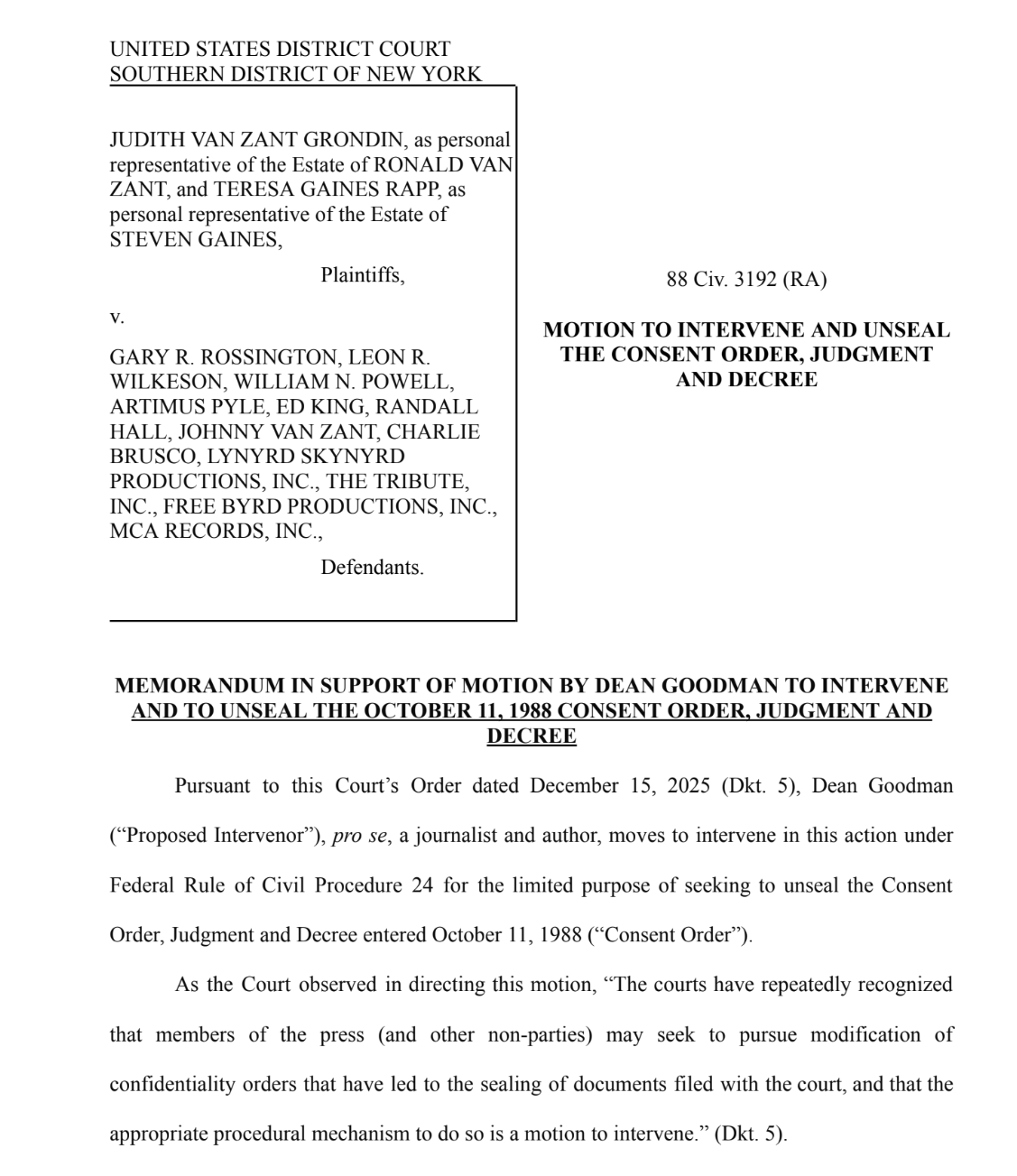
Here’s the first page of the motion (12 pages in all). Yes, I wrote it all myself and it took months of research and editing.
What happens now?
The other side has four weeks to respond, and I have two weeks to respond to the response. The judge will then issue an opinion. I should clarify that Artimus was not involved in this matter. This is simply some old-fashioned journalistic vigour. Most important of all, I’m using em-dashes in this article because that’s what writers do. It has nothing to do with A.I.